CS2 Rush Hour: silent reloads, Premier’s pick-four, and a new 3v3 mode
This article was researched and drafted by Softcap staff, then edited by Sam Okonkwo. Sources are linked.
Valve’s Rush Hour package for Counter-Strike 2 landed on Steam on 22 September 2026 as a competitive quality-of-life drop, not a weapon-damage rebalance. In one publish window Valve rewrote how Premier picks a map, shipped a queued 3v3 mode called Rush, changed how reloads and sniper unscopes sound, rebuilt crosshair settings around resolution-independent pixels, repaired geometry on four maps, and published a full run of misc, Workshop, and scripting notes. The account below is grounded in Valve’s Rush Hour post and the matching Counter-Strike 2 Update announcement from the same day.
The competitive story is the through-line. Premier’s old ban-down-to-one ritual is gone. Mid-round audio now lets players trade time for quiet. Casual and party queues get a new mode with a friends leaderboard. Everything else in the note — grenade purchase caps, chicken Zeus damage, Clan Tags, C4 stickers, a music kit, scoreboard and kick-ban fixes, Source 2 engine code, Workshop entities, scripting hooks — is part of that same primary text and belongs in a full explainer rather than a stub.
Primary sources: Rush Hour and the matching Counter-Strike 2 Update notes (Steam News API gid 1844751498216924 when the community detail URL soft-404s).
Premier map selection, rewritten
Valve opens the update notes by saying the Premier map-selection process was updated to give players more opportunities to play maps they have been learning. The Rush Hour post says the same thing in plainer language: if you spend a lot of time developing strategies on a map, you should have a chance to benefit from that investment. That is Valve’s framing. How often a favorite map will actually roll is not something Valve published in these notes.
The mechanical change is specific. Instead of banning down to a single map, teams pick into a four-map pool, then the server randomly selects one of those four and the match begins. The order in the update notes is unambiguous:
Team 1 picks one map. Team 2 picks two maps. Team 1 picks a final map. One of the four maps will be randomly selected and the match will begin.
That is the whole process. There is no leftover ban phase in the published text. For Premier stacks, the practical shift is from last-ban leverage to pick strategy plus a random roll among four agreed maps. Teams that invest in a deep map pool still have to accept that the final map is not a guaranteed favorite; it is one of four picks chosen at random after the pick phase completes.
Rush: queued 3v3 through random arenas
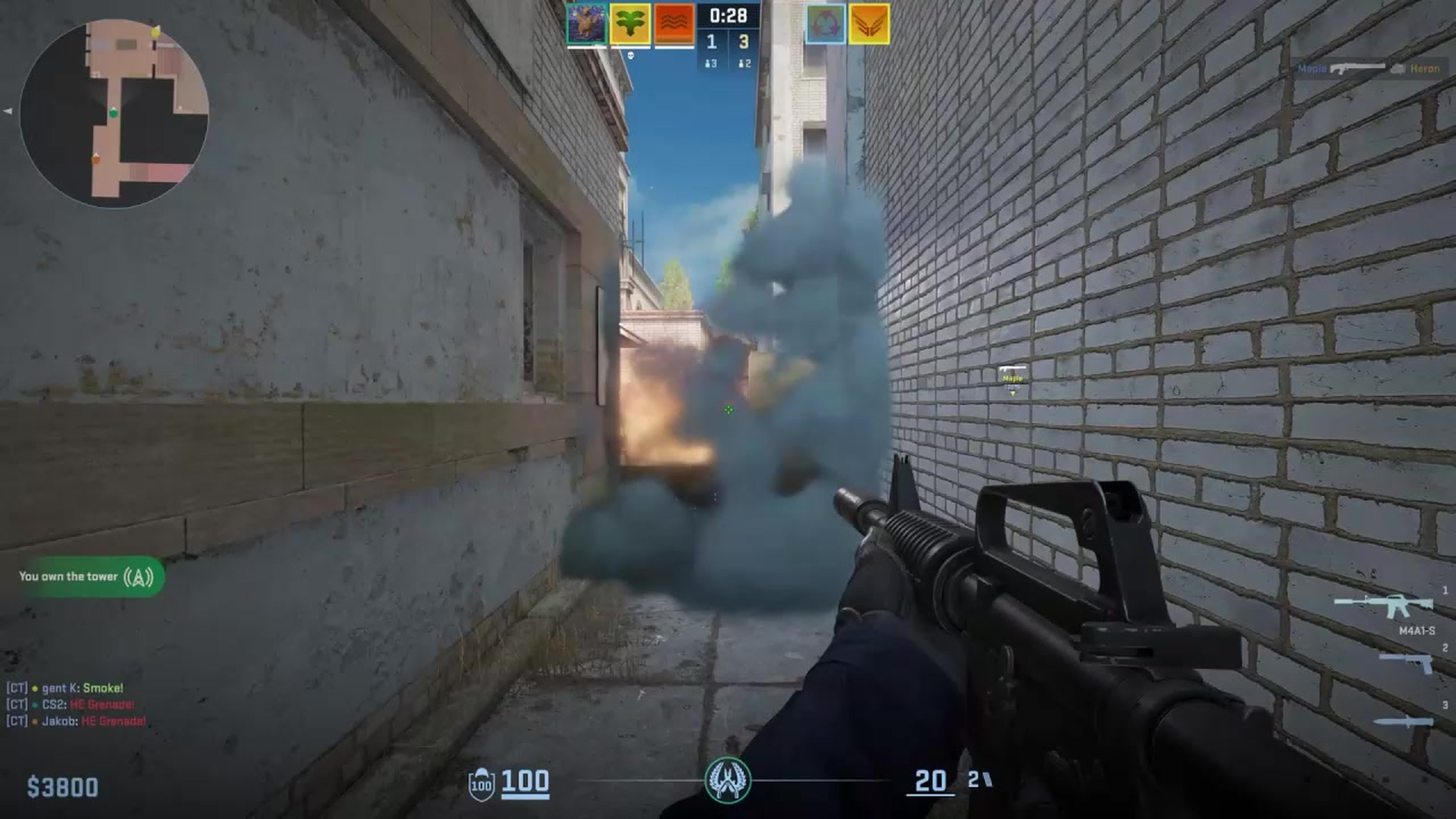
Rush is the mode that gives the update its marketing name. Valve describes it as a fast-paced queued 3v3 game mode. Players battle through a series of battle arenas to reach the opponent’s castle and win the match. Battle arenas are randomly selected for each match, so no two matches are the same. Control the tower when you eliminate the enemy team, or when time expires, to win the round.
The Rush Hour post layers product language on top of those rules without changing them: put your foot on the gas; advance through a gauntlet of randomly selected battle arenas; make the most of a limited budget and precious time to clear the objective; run the gauntlet to capture the enemy castle; keep track of wins and compete for bragging rights on the Rush friends leaderboard.
Taken together, the primary text describes a short-form competitive-adjacent queue: three players a side, random arena sequences, a castle objective, a tower-control win condition after an elimination or a timeout, and a friends leaderboard for tracking results. Valve did not present Rush as a Premier replacement; it shipped the mode inside the same competitive QoL package as the Premier pick rewrite.
Gameplay: stealth at a time cost
The update’s stealth lines are short and concrete. Players can now reload silently, but slowly, by pressing and holding the reload key. Un-scoping a sniper weapon no longer produces a sound. Valve’s Rush Hour copy says silent reloads take quite a bit longer, and that unscopes are now perfectly silent. That trade-off is competitive information design — quieter magazine changes and quieter scope exits on a hold-key time cost — not a cheat or tooling story.
The same gameplay section also raises global visual clarity and improves the fidelity of bullet impact decals. The Rush Hour post puts that in blunt terms: blood is now much more bloody, and bullet impacts are far more impacty. The update notes are the cleaner primary for the mechanical claim; the marketing post is the primary for Valve’s own wording.
Two smaller gameplay rules close the section. The ammo_grenade_limit_total setting now also enforces the total number of grenades a player is allowed to purchase in a round. Chickens now take damage from the Zeus x27. Both lines are in the published update notes and are part of complete coverage even though neither is the headline.
Settings: resolution-independent crosshairs
Crosshairs have been updated to be resolution independent. A new “Crosshair/Scopes” tab is available in the Settings menu and includes updated crosshair settings. Valve added new crosshair styles and updated the default crosshair to “Dynamic Quad,” which the notes say better represents weapon accuracy. The Rush Hour post points players at the same Crosshair/Scopes settings and the new shapes without adding different numbers.
For competitive players who rebuild crosshairs after every UI pass, the actionable primary facts are: resolution independence, a dedicated Crosshair/Scopes tab, new styles, and a new default named Dynamic Quad. Valve did not publish pixel recipes in the Rush Hour-day notes.
Engine
Valve updated engine code to the latest version of Source 2. That is the entire engine line in the primary update — a systems bump, not an independently measured performance claim.
Map fixes on Ancient, Cache, Mirage, and Train
The maps section is a repair list, not a redesign pass.
On Ancient, Valve fixed holes in the world in Long A Main Hall and adjusted door geometry and grenade clipping inside Jaguar. On Cache, Valve shipped gap fixes and clipping adjustments around the blue doors in Mid. On Mirage, Valve reinforced scaffolding by the balcony on A site. On Train, Valve blocked a pixel gap in crates on bombsite A.
Those four maps and those four repair descriptions are the complete maps block from the Rush Hour-day update. This explainer covers that package only; earlier Cache workshop-era notes are out of scope here.
Misc: Clan Tags, C4 stickers, music, and matchmaking hygiene
Players who are members of Steam Community Groups can set a Clan Tag. The tag is adjustable from the Player Profile and appears next to the player name. The Rush Hour post says Clan Tags are back and that selecting a Steam Group in the player profile surfaces the tag wherever you play. Stickers can now be applied to the C4.
The Starjunk 95, Industrial Sunset Memories Music Kit is available for purchase in standard and StatTrak versions through the STORE tab. The Rush Hour post introduces the kit as featuring the sounds of Starjunk 95 and calls it music from the grooviest station in the galaxy; the update notes supply the full product name and the StatTrak availability.
Halftime scoreboard stats should now fully reflect the results of the previous round. Valve fixed a case where players could avoid a kick ban. Players can now adjust music volume per game mode. The kick-ban line is reported as Valve wrote it: a fix for a case where players could avoid a kick ban — not a broader enforcement narrative.
Workshop and scripting additions
Workshop creators get these new entities in the published note. minimap_volume enables a custom minimap image when a player is within the volume. sky_camera_volume and sky_camera_volume_target enable custom location-specific skybox rendering. point_deathcam_bounds constrains the player death camera. env_shake_volume allows camera shake only within a specified volume.
The scripting block adds the CSRadarPoint and CSObservablePoint entities, an AddTeamMoney API method, an OnPlayerTeamChanged callback, and support for a localization string in SetDialogVariableString. Those names are taken from the primary update text; usage patterns beyond what Valve published are not documented here.
Who this hits
Premier teams lose last-ban leverage and now live with a four-map pick pool that rolls randomly into the match. Players who manage mid-round information get a hold-to-reload silent magazine change at a clear time cost, plus a silent sniper unscope. Party queues get Rush, random arenas, a tower-control win condition, and a friends leaderboard. Custom content creators get the Workshop and scripting surface listed above. Everyone else still eats the QoL and hygiene lines: impact clarity, crosshair defaults, Clan Tags, C4 stickers, the Starjunk 95 kit, scoreboard and kick-ban fixes, per-mode music volume, Source 2 code, and the four map repairs.
Why it matters
Rush Hour is a competitive-policy and systems package, not a weapon buff sheet. The Premier pick-four rewrite changes how ranked matches start. The silent reload and silent unscope change how sound reads in gunfights. The grenade purchase enforcement, chicken Zeus damage, Dynamic Quad default, Clan Tags, C4 stickers, Starjunk 95 music kit, scoreboard and kick-ban fixes, per-mode music volume, map geometry repairs, Source 2 bump, and Workshop/scripting API list are all in the same published update, and they all belong in a complete reading of the patch.
Sources
Related reading
Valheim 1.0 explained: Deep North biome, Kall Fimbulbringer, and the post-launch hotfix sheet
Iron Gate’s Valheim 1.0 (9 Sep 2026) exits Early Access with the Deep North biome, 40+ weapons, moose mounts, kall boss fight, crossplay, and achievements — plus Softcap’s read of the live 1.0.15 hotfix line.
No Man’s Sky Cosmos explained: space stations, hulks, alliances, and Our Journey Continues
Hello Games’ free Cosmos (Update 7.0) rebuilds deep space — Station Directorship, galactic alliances, orbital bases, derelict hulks with Tractor Beam salvage, a star system map, and Expedition 23 Our Journey Continues, plus the live 7.04 hotfix sheet.
Deadlock 09-16-2026 explained: comeback souls reworked, slows cut ~20%, Celeste and Warden nerfed
Valve’s Minor Update 09-16-2026 scales Unstable Rift comeback resist over match time, cuts global move slows ~20%, rewires Shiv rage knives, buffs Holliday and Silver, and nerfs Spiritual Overflow, Decay, and Mercurial Magnum.